Artist Branding Starts at the Roots — Not the Visuals
There's a question we get from independent artists all the time. Some version of: should I get a better logo? Should I redo my photos? My Instagram looks inconsistent.
And the answer is almost always: that's not your real problem.
Visuals, tone of voice, colour palettes — all of that matters. But it's the last thing to figure out, not the first. When artists focus on the surface before the foundation, they end up with a brand that looks fine and feels like nothing. There's no pull to it. No reason to follow. No universe to enter.
Starting at the wrong end
Most branding advice for artists starts with visuals. Pick your aesthetic. Decide on your colours. Get a logo. Shoot some content.
But if you think about a tree, you don't grow leaves before you have roots. The leaves are the last thing to come — they're the visible expression of everything underneath. Start there, and you're decorating something that has no structure to hold it up.
The framework we use in the accelerator works in the opposite direction. Five layers, built from the ground up:
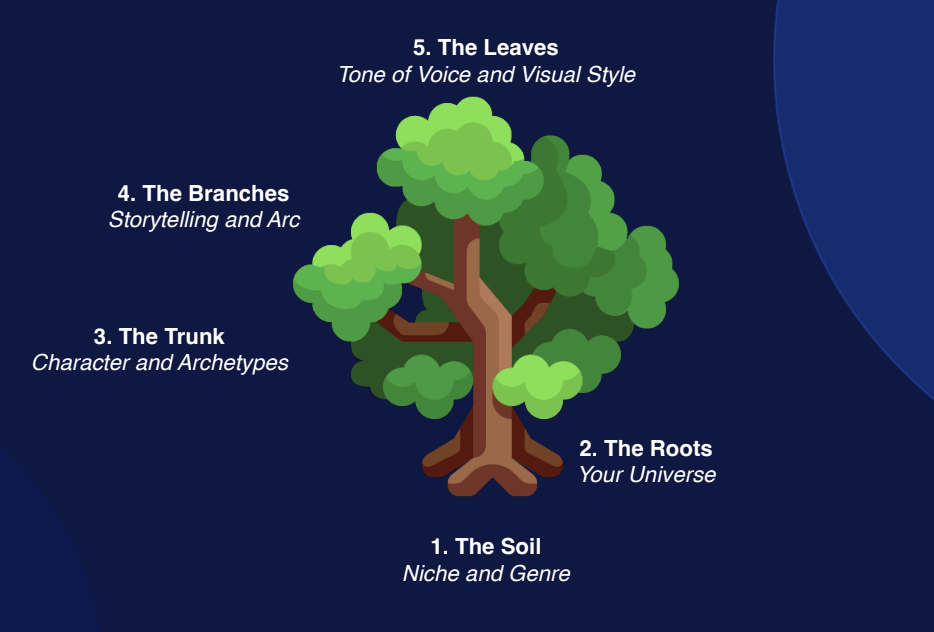
The Soil — your niche and genre. Not "pop" or "rap" but something precise enough to actually mean something. Nostalgic old-school rap. Dark melodic techno. Emotional indie folk for people who journal at 2am. The more specific, the better — because specificity is what makes you findable, memorable, and easy to love.
Define Your Niche:
- ❌ Rap
- ✅ Nostalgic Old-School Rap
- ✅ Emotional Rap / Emo Rap
- ✅ Lo-Fi Chill Rap
Examples:
- Playboi Carti - Rage / Hyper Trap
- CHVRCHES - Nostalgic 80s Synth Indie
- ARTBAT - Dark Melodic Techno
The Roots — your universe. What world does your music exist in? What time does it live in — the past, the present, something imagined? Is it a specific place, or an abstract feeling like "Hotel California"? David Bowie built an entire universe of futuristic characters and then invited people in. Lana Del Rey made you feel like you were nostalgic about a Hollywood you'd never actually lived through. That's the roots doing their job.
Questions:
- When do the events of your brand's universe unfold?
- Where does the story take place?
- What specific actions demonstrate your principles and values?
Examples:
- Time: The past (Lana Del Rey nostalgizing about the Hollywood era), the future (FKA Twigs)
- Place: Specific real locations, or abstract/fictional spaces like "Hotel California".
- Action: Going on an adventure, breaking the rules, etc.
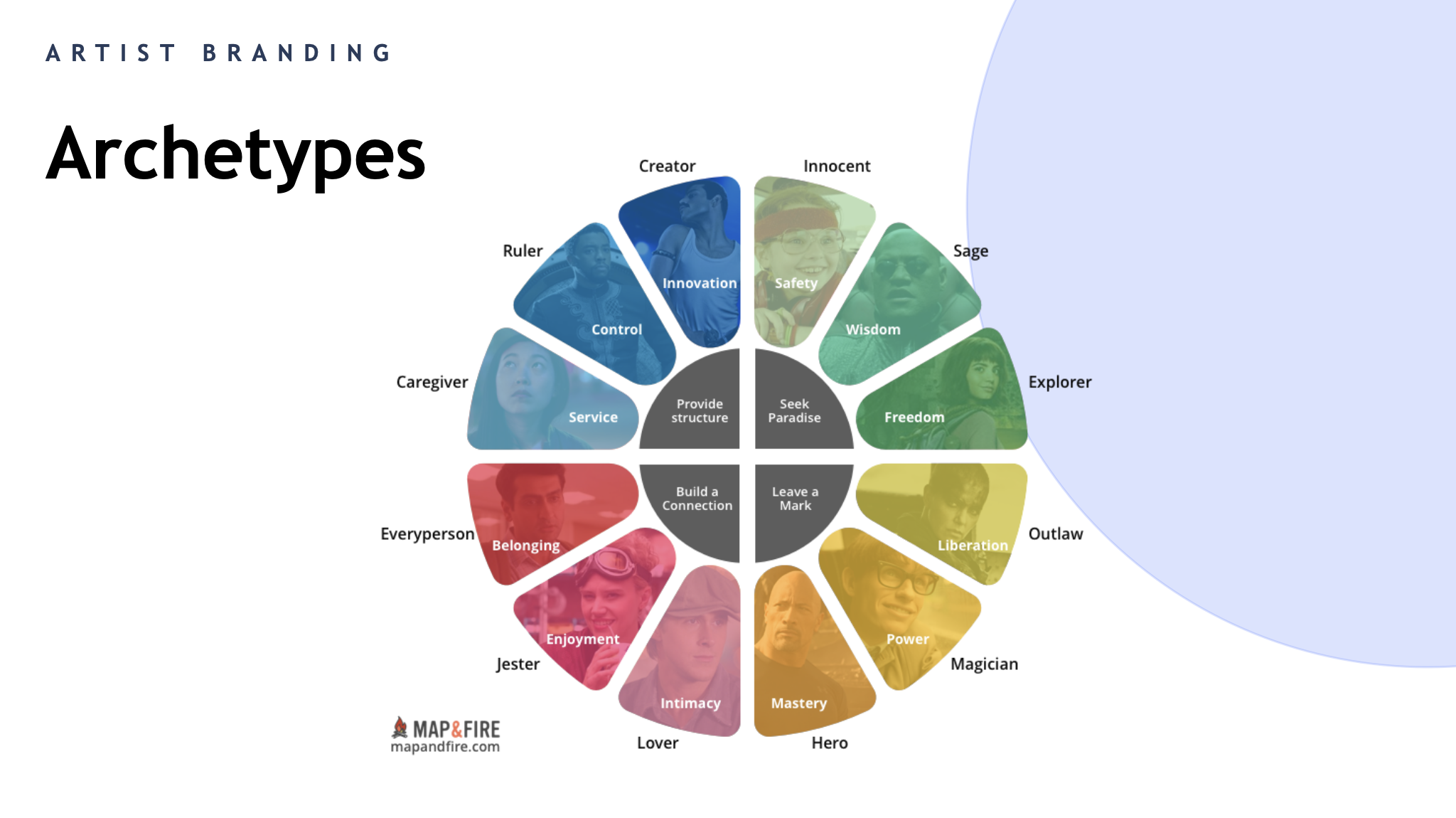
The Trunk — your character and archetypes. This is where psychology enters. Every enduring artist persona is built on archetypes — the Rebel, the Lover, the Jester, the Sage. The recommendation is one driving archetype that determines your core motivation, supported by two secondary ones that add texture. Nirvana: Rebel at the core, with Everyman and Innocent underneath. Sabrina Carpenter: Lover at the core, with Jester and Creator adding the irony and the 1950s Hollywood reimagining.
Questions:
- What is your main archetype (which determines your primary motivation), and what are your two additional archetypes?
The Branches — your storytelling and arc. What's the internal narrative? What are you moving through, and what do you want people to feel they're witnessing? Taylor Swift's arc has always been the underestimated outsider demanding her version of events — and she's developed that across every album era. The character evolves, which is why people follow her across decades rather than just liking one record.
Questions:
- What are your internal and external motivations? What are your key fears and desires?
Example (Taylor Swift):
- “Let me tell you what really happened.”
- The outsider, The underestimated girl, The misunderstood narrator
- Different Narratives Across Eras
The Leaves — tone of voice and visual style. Only now. Your signature look, your specific colours, how you write a caption, whether you're dry or warm or chaotic. This is where the brand becomes visible — but it only works if everything underneath is solid.
Questions for Tone of Voice:
- Imagine you are an amusement park: what rides are there (are they scary, extreme, or teacups)?
- What do you allow visitors to do in your park, and how do you convey these rules?
- What questions do you ask them, and what answers do you provide?
Questions for Visual Style:
- What is your signature attribute or visual feature?
- What fonts, aesthetics, and types of shots do you use?
- Do you speak fast or slow, directly or in symbols? What are your specific colors or patterns?
Examples:
- Attributes: A distinct hairstyle or a physical object, like the speaker's own synthesizer.
- Colors: Olivia Rodrigo focusing on purple, Beyoncé on silver, and Charli XCX on acid green.
- Patterns: PinkPantheress using plaid, or the Florence + the Machine using mystical elements
The question nobody wants to answer
The hardest part of this framework, genuinely, is the roots and trunk. Not because they're complicated — because they require you to look at yourself clearly, from the outside.
One of the artists in our first Korda Artist Accelerator cohort said it directly: it's super hard to see yourself outside of your own mind.
That's completely normal. And there's a practical shortcut: ask three people who know your music well to give you three words they associate with it. Not your personality — specifically your music. You'll almost always be surprised. People often think of their sound as futuristic or playful, and their listeners consistently say something like "melancholy" or "cinematic."
Authenticity vs. construction — there's a nuance here
Let's take Taylor Swift — she constructs her archetype deliberately. It's not just raw self-expression — it's a carefully built image. And as a listener or fan, you might genuinely not care that much about an artist's personal backstory. You care about how the music makes you feel and the world it creates.
Both things are true.
You can absolutely construct a character — and the best artists do. But the archetype you choose still needs to connect to something real in you, because the moment it doesn't, everything stops being consistent. If you write emotionally heavy, raw music, but then your Instagram voice is breezy and ironic, people feel the disconnect without being able to name it. They just stop trusting the world you're building.
There's a phrase I keep coming back to: there's a difference between being open and being naked. You don't owe anyone your entire story. But what you do show needs to actually be yours.
Artist Branding Checklist
If you want to apply this framework, here are the questions worth sitting with:
Soil: What is your genre, precisely? Not the broad category — the specific sub-niche. What do people do while listening? What atmosphere does it create?
Roots: What time and place does your music live in? Is it a real location or an invented one? What values does it embody?
Trunk: What's your primary archetype — your core motivation? What two supporting archetypes add complexity to that?
Branches: What's your narrative arc? What's the story you're telling across your releases, not just within each one?
Leaves: Only now — what does all of the above look like visually and sonically? What's your signature?
You don't need to have perfect answers. You need to start somewhere real, and then refine as you go.
That’s exactly what we dive into in the Korda Artist Accelerator. Want to be part of it? Apply here.
Korda builds tools, community, and education for independent artists who want to own their careers. If this resonated, subscribe below—we publish weekly. Questions: hello@korda.co